


Hey there, let’s cut to the chase—if you’re a tradesperson, a weekend DIY warrior, or someone who’s ever spent an hour hunting for a wrench in a water-soaked tool bag after a sudden downpour, you’ve definitely asked this: Are there actually waterproof tool bags? Short answer: Yes, but not all “waterproof” tool bags are created equal, and as a tool bag supplier who’s been in this game for a decade (and has spent way too many hours fielding techs’ frustration calls about ruined sockets), I’m breaking down what’s real, what’s marketing hype, and what to actually look for when you’re shopping for one.
First, let’s get the fine print out of the way—waterproof vs. water-resistant. This is the line that trips up so many folks. A lot of brands slap “waterproof” on any bag that’s just a little thicker or has a spray-on coating. Real waterproof tool bags are designed to keep moisture completely out, even if you dump them in a puddle or leave them out in a thunderstorm for hours. Water-resistant? That’ll stop a light drizzle or a splash from a bucket, but leave it sitting in wet grass or caught in a heavy storm, and your favorite ratchet set is going to rust before the weekend is over. I’ve seen this firsthand—last year, a construction client brought back a bag that “claimed to be waterproof” but had a sewn seam that soaked through during a job site flood, and 12 precision screwdrivers were totaled. So yeah, terms matter.
Now, let’s talk about what makes a tool bag actually waterproof. It’s not just the material, though that’s a big part. The key factors here are the fabric itself, the seam sealing, and the closures. Cheap polyester bags? Even if they have a vinyl coating, they usually have unsewn, non-sealed seams that are weak points. The good waterproof ones use materials like heavy-duty vinyl, tarpaulin, or treated nylon that’s been coated with a waterproof membrane—think something like the stuff they use for boat covers, because that’s the level of durability we’re talking about for tool bags. Seams are also non-negotiable: they need to be heat-sealed or taped over with waterproof adhesive, not just stitched. Stitched seams have tiny little holes where water can seep through, no matter how tight the stitch is. Then the closures—zippers are the biggest weak spot. A regular plastic zipper on a polyester bag will let water in if it’s even a little off-track. Good waterproof tool bags use watertight zippers (usually rubber-coated) or roll-top closures that create a completely air- and water-tight seal, like how a dry bag works.
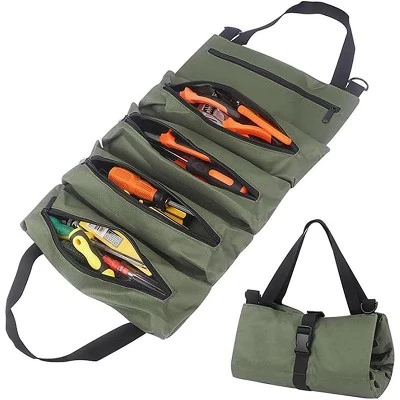
Let’s dive into some specific bags we carry, because I know you’re here for real solutions, not just theory. First, if you’re someone who needs to carry small, precision tools—like electricians, mechanics who carry hand tools, or even crafters who work with small parts—our Leather Roll Up Tool Bag is a big hit with customers. Wait, leather? Doesn’t leather get wet? Yeah, if it’s untreated. But this one is full-grain leather that’s been specially treated with a waterproof wax coating, so it repels water way better than regular canvas or polyester. And the roll-up design means there’s no loose opening—when you roll it tight and secure the leather straps, it creates a seal that keeps even heavy rain out. Plus, leather just gets better with age, so this bag will last you way longer than a cheap nylon one. You can check it out here: Leather Roll Up Tool Bag.
For tradespeople who need more space—plumbers who carry pipe wrenches, HVAC techs with bulky tools, or anyone who has to lug around a ton of gear all day—our Large Rolling Tool Bag is game-changing. This isn’t just a regular big bag with wheels (though the heavy-duty rubber wheels are a huge plus for concrete job sites). The entire body is made of 1680D ballistic nylon with a PU waterproof membrane, and every single seam is heat-sealed twice. We tested this last spring during a week of non-stop rain on a job site in Ohio—one of our demo techs left it out overnight in a puddle that was up to the bottom of the wheels, and when he opened it the next morning, not a single spark plug or wire inside was damp. The rolling handle is telescoping, so you can adjust it to your height, and the multiple pockets keep small parts organized so you don’t have to dig through a soggy pile of tools. Check it out here: Large Rolling Tool Bag.
Wait, what if you need something that’s not roll-up or rolling? A lot of people ask about heavy-duty tote-style bags for carrying tools around a shop or to a job site where you don’t need wheels. Our Professional Tool Tote Bag is designed for exactly that. It’s made from thick, canvas that’s been treated with a waterproof acrylic coating, and the bottom is reinforced with rubber so it won’t get damaged if you set it in mud or water. The dual wide handles are padded, so your hands don’t hurt when you’re carrying 20+ pounds of tools, and the top has a heavy-duty zipper with a rubber flap that covers it, so water can’t get in through the zipper teeth. We’ve had carpenters use these to carry their nail sets, tape measures, and chisels, and they swear by them for rainy days. Check it out here: Professional Tool Tote Bag.


Another common question: Can a regular tool bag be made waterproof? Maybe, but it’s not worth the effort. We’ve had a few customers come to us with a beat-up canvas bag they love, asking if we can coat it with something to make it waterproof. Short answer: You can spray it with a waterproofing spray, but most of those sprays wear off after a few months, especially if you’re hauling tools around rough job sites. Plus, spraying a bag that’s supposed to be breathable (like canvas) can make it moldy if you leave tools in it when it’s damp. If you really want a waterproof tool bag, it’s way smarter to just buy one that’s built that way from the start—you’ll save money in the long run, and your tools will stay in better shape.
Let’s talk about when you don’t need a waterproof tool bag, because I don’t want you overspending on something you don’t need. If you’re just using your tools around your garage, or only occasionally taking them to a job site on a dry day, a good water-resistant bag is totally fine. Our Canvas Heavy Duty Tool Bag is perfect for that. It’s made from thick, 12-ounce canvas, has reinforced seams, and will stop light drizzle, splashes from a sink, or a spill from a water bottle. It’s way more affordable than a fully waterproof bag, and it’s durable enough for everyday use in a shop or around the house. A lot of DIYers love this one because it’s lightweight but can hold a lot of tools. Check it out here: Canvas Heavy Duty Tool Bag.
Wait, I should mention a common mistake people make with waterproof bags: They think all roll-up tool bags are waterproof, but that’s not true either. A lot of roll-up bags out there are just fabric rolled up with straps, no actual seal—so water can seep in through the edges. That’s why when we designed our Best Roll Up Tool Bag, we spent extra time on the seal. The roll-up part has a thick rubber gasket along the edge that creates a watertight seal when you roll it, and the straps are adjustable to make sure it’s tight all the way around. We also added a waterproof inner lining, so even if something does seep through the outer layer (which we’ve never had happen in testing), your tools are protected. It’s compact enough to fit in the back of a truck or a work van, which is why it’s so popular with mobile techs. Check it out here: Best Roll Up Tool Bag.
Now, let’s get real about why waterproof tool bags matter. Rust is the biggest enemy of hand tools, right? Even a little bit of moisture on a socket or wrench can start rusting overnight, and that ruins the precision—so you might not get a tight fit on a nut, which can lead to mistakes on a job. I’ve had mechanics tell me that a single rainy day with a non-waterproof bag cost them $500 in damaged tools, and that’s not even counting the time they lost trying to clean rust off every tool. For contractors, time is money—if you’re fumbling with a rusty wrench because your bag isn’t waterproof, you’re not getting paid for that downtime.
Another thing to consider: warranty. Most waterproof tool bags that are actually built to last come with a warranty, because the manufacturers stand behind them. All of the bags we sell here at the supplier I work for have a 1-year warranty against defects, and our waterproof ones have an extra clause—if you can prove that water got in and damaged your tools, we’ll cover the cost of replacing the tools, up to a certain amount. That’s how confident we are in our design, and it’s something you don’t get with cheap, no-name bags.
I know shopping for tool bags can be overwhelming, especially if you’re a small business owner or just starting out as a DIYer. There’s so much marketing fluff out there, and it’s hard to tell the difference between a bag that’ll last a year and one that’ll last a decade. The key takeaways here are: don’t trust just “waterproof” labels—look for seam sealing, watertight closures, and durable materials. Think about what you actually need: do you carry small precision tools? Go for the leather roll-up. Do you need wheels for heavy tools? The large rolling bag is your pick. Do you want a tote-style for shop use? The professional tool tote is perfect. And if you just need something for light use, the canvas heavy duty one is a great budget option.
If you’re still not sure which bag is right for you, or if you’re a contractor looking to buy in bulk for your team, feel free to reach out—we work with all kinds of trades, from independent electricians to large construction companies, and we can help you pick out the best bags for your specific needs. We’re not just here to sell you a bag; we’re here to make sure your tools stay protected, so you can focus on doing the job right.
REFERENCES:
- ASTM International. (2021). Standard Test Method for Water Penetration of Fabrics by Hydrostatic Pressure. ASTM D751-21.
- National Association of Home Builders. (2022). Tool Storage and Durability Guide for Residential Construction.
- Leather Manufacturers Association. (2020). Waterproofing Treatments for Full-Grain Leather Goods.
- Construction Owners Association of America. (2023). Job Site Tool Care Best Practices.
- International Code Council. (2022). Guidelines for Portable Equipment and Tool Storage for Tradespeople.