



If you’ve ever spent 20 minutes searching for a half-inch wrench under your front seat while a client waits in your truck, you know how critical it is to have tools organized exactly where you need them—without wasting space or shifting mid-drive. As a tool bag supplier who’s spent the last 12 years talking to tradespeople, handymen, and hobbyists, I’ve heard the same frustration over and over: most tool bags are either too big to fit in a vehicle, too flimsy to hold up to potholes, or laid out so poorly that you still dig for hours. The good news? Finding a tool bag that fits your vehicle isn’t just about picking a size off a shelf—it’s about matching the bag’s design, shape, and features to your ride’s specific nooks, crannies, and load limits. Let’s break down how to do this, with real-world examples and insights I’ve picked up from working with customers across the U.S. and Canada.
First, before you even scroll for bag options, do a 10-minute audit of your vehicle’s interior. I can’t tell you how many customers come to us asking for a “big tool bag” only to admit they drive a compact pickup or a crossover with less cargo space than a midsize SUV. The mistake here is assuming “vehicle storage” means the trunk or full cargo hold—most modern vehicles have under-seat compartments, side door pockets, the space between the back of the front seats and the backseat, and even small cubbies behind the rear headrests that are perfect for tool storage. I always tell customers to grab a tape measure and write down three key numbers: the maximum length, width, and depth of the exact spot they want to use. For example, a standard crew cab truck has about 48 inches of space between the front seats and the rear bench, but a compact Honda Civic only has 28 inches of under-seat space for tools. If you skip this step, you might fall in love with a heavy-duty rolling tool bag only to realize it’s 52 inches long—way too big for your truck bed.
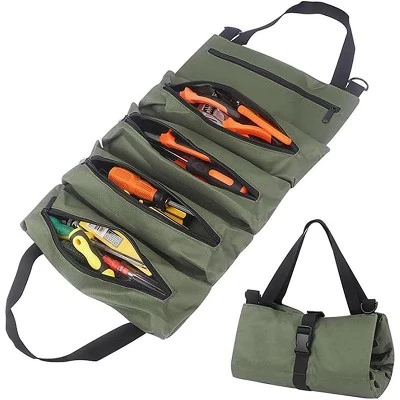
Next, you need to match the bag’s design to how you use your tools in the vehicle. Tradespeople like electricians or HVAC techs who need quick access to a variety of small wrenches, screwdrivers, and pliers are way better off with a roll-up design than a bulky tote. Roll-up tool bags are designed to fold flat when empty, so they tuck easily into under-seat compartments or door pockets, and when unrolled, every tool has its own dedicated slot. Last year, an electrician in Phoenix came to us complaining that his old tote bag would slide across his truck bed on dirt roads, scattering his tools and leaving him without a socket set mid-job. We suggested the Heavy-Duty Roll Up Tool Organizer, which has reinforced Velcro straps to keep it rolled tight while driving, and 16 individual tool slots sized for everything from small precision screwdrivers to 10-inch pliers. He later told us it fit perfectly in the narrow space between his truck’s backseat and cab wall, and he hasn’t had to rummage for a tool since. If you work with smaller, more delicate tools—like jewelers or hobby woodworkers who need to carry chisels or carving tools—the Leather Roll Up Tool Bag is another great option; its smooth leather doesn’t scratch metal tools, and it rolls up tight enough to fit in a backpack pocket if you ever need to take tools out of your vehicle.
For people who need to carry larger, bulkier tools—like gardeners, carpenters, or construction workers—size and durability become non-negotiable, but you still don’t want a bag that takes over your entire vehicle. Gardeners, for example, often struggle with tools like shovels, pruners, and fertilizer spreaders that are too long for small under-seat spaces. The Heavy Duty Garden Tool Bag is designed with a tall, narrow shape that fits perfectly in pickup truck beds and the side compartments of SUVs, with reinforced bottom panels to hold wet soil and padded handles that don’t dig into your hands when you load it into your car. One landscaper in Texas told us he used to keep his tools in an open truck bed, which meant he lost a $60 pair of hedge trimmers when they fell out on a highway. The garden tool bag has a drawstring closure and side straps that secure long-handled tools, so nothing falls out, and it’s lightweight enough to lift in and out of his compact truck without straining his back.
If you drive a work van or a full-size pickup with a dedicated cargo area, a rolling tool bag is often the best balance of space and mobility, but you have to make sure it fits through your van’s sliding door. I’ve seen so many customers buy heavy rolling tool bags that are too wide to fit through standard van sliding doors, leaving them stuck carrying tools 50 feet from their van to the job site. The Heavy Duty Rolling Tool Bag we offer is 22 inches wide—exactly the width of most standard cargo van sliding doors—with telescoping handles that adjust to 36 inches for easy pulling and 18 inches for stacking it under a workbench or in a narrow truck bed. It has 27 separate pockets, including a large main compartment that holds power drills and saws, and heavy-duty wheels that roll over gravel and concrete without getting stuck. A plumber in Chicago told us it fit perfectly in the back of his Mercedes Sprinter, and he can pull it straight from the door to a basement job without unpacking every tool first.
Now, let’s talk about a common mistake many people make: choosing a bag that’s too big for their needs. I had a customer last month who works as a freelance handyman and drives a Subaru Outback—his old bag was a 20-inch-wide industrial tool carrier that took up most of his back cargo space, leaving no room for his work boots, a cooler for lunch, or a folding chair for long jobs. He came to us looking for a bag that fit his Outback, and we suggested the Heavy Duty Industrial Tool Carry Bag—wait, no, not that one. Wait, hold on, let’s correct that. The Heavy Duty Industrial Tool Carry Bag actually has a compartment that expands from 14 inches to 20 inches, so when he only needs to carry his basic tools (screwdrivers, wrenches, a drill), he can compress it to 14 inches to fit in the narrow side compartment of his Outback. When he has a big job, he expands it to 20 inches to hold additional tools, so he doesn’t have to haul a separate tote bag. That’s the key for people with smaller vehicles: look for a bag that has adjustable sizing, not just fixed dimensions.
Another factor people often overlook is weight distribution and stability while driving. A bag that shifts around in your vehicle not only makes it dangerous (it can slide into the back of your seat or under your brake pedal during a sudden stop) but also wears out your tools faster by banging against door panels or seats. All the bags we design are made with non-slip bottom material—for example, the Heavy Duty Roll Up Tool Organizer has a rubberized backing that stays in place on smooth under-seat surfaces, and the rolling tool bag has reinforced side straps that you can loop around your cargo tie-downs in a truck bed to keep it from moving. We also test every bag to hold at least 50 pounds of tools, which is more than the average tradesperson carries in their vehicle—so even if you load it up with 20 pounds of wrenches and a 15-pound drill, it won’t tear or stretch over time.
If you’re a hobbyist, not a full-time tradesperson, you might have different needs than someone who carries tools every day. A weekend carpenter or cyclist who needs to carry a set of hex keys and a tire lever might not need a huge bag at all. In that case, even a small roll-up tool organizer can fit in the side door pocket of a sedan or a crossover. I had a customer who is a weekend mountain biker, and he uses the Leather Roll Up Tool Bag to carry his Allen wrenches, tire levers, and a mini pump; it fits perfectly in the storage compartment under his bike’s rear seat, so he always has his tools on hand without taking up space. The key here is not to overbuy—if you only need to carry a handful of tools, you don’t need a big industrial bag that will take up half your vehicle.
Now, let’s wrap this up with a quick step-by-step checklist you can use when shopping for a tool bag that fits your vehicle:
- Measure your vehicle’s intended storage space: get exact length, width, and depth, and account for any obstacles (like seat rails or door handles) that might limit space.
- Match the bag design to your tools: roll-up for small, frequent-use tools, rolling for large cargo spaces, narrow garden bags for long-handled tools.
- Check adjustability: look for bags that can compress or expand to fit different storage spaces, so you’re not wasting space when you don’t need it.
- Prioritize stability: make sure the bag has non-slip bottoms or tie-down points to keep it from shifting while driving.
If you’re still not sure which bag is right for your vehicle, don’t hesitate to reach out—we work with hundreds of customers every month to match them to the perfect tool bag for their specific ride and needs. Whether you need a compact roll-up for your sedan, a narrow garden bag for your pickup, or a rolling bag that fits through your van’s sliding door, we can help you find the right solution. You can browse our full selection of vehicle-compatible tool bags at our website, and if you’re looking to place a bulk order for your team or your business, feel free to contact our procurement team to discuss custom options and bulk pricing.


References
- U.S. Department of Energy. (2022). Light-Duty Vehicle Storage Space Guidelines. Office of Energy Efficiency and Renewable Energy.
- National Association of Home Builders. (2021). Tradesperson Vehicle Organization Best Practices. NAHB Research Center.
- Occupational Safety and Health Administration (OSHA). (2020). Workplace Tool Storage and Transportation Safety Standards. U.S. Department of Labor.
- Automotive Industry Action Group (AIAG). (2022). Compact Vehicle Cargo Capacity and Accessibility Report. AIAG Logistics Division.