



If you’ve ever hauled a large power drill, a 10mm socket set, a cordless jigsaw, and a half-dozen miscellaneous hand tools across a worksite, up a flight of project stairs, or through a crowded parking lot, you know the small, annoying details that turn a routine task into a back-and-forth nightmare. For years, I’ve talked to professional tradespeople—carpenters, electricians, HVAC techs, plumbers, and even some freelance filmmakers who tote gear to set locations—about the biggest pain points they deal with when transporting tools. One question comes up more than any other, and it’s the reason I decided to write this post: Do large rolling tool bags have a padded handle?
The short answer is: Most high-quality ones do, but that’s not a one-size-fits-all rule. As a supplier of large rolling tool bags, I’ve spent the last 12 years testing, modifying, and refining these bags based on real feedback from the people who use them every single day. Too many budget models skip small, meaningful features like padded handles to cut costs, and that’s where we’ve focused our efforts—because a tool bag that hurts your hand after 10 minutes of pulling it is just a dead weight you have to drag around, not a useful asset.
Let’s break this down. First, it’s important to distinguish between different types of rolling tool bags, because handle design varies wildly depending on the bag’s purpose, size, and weight capacity. For example, you’ll find small rolling tool bags for home DIYers that are only 18 inches long, hold a handful of basic tools, and weigh less than 5 pounds when empty. These almost never have padded handles—there’s just not enough space in the small frame, and the total weight of the contents is light enough that a thin, rigid handle works fine. But when you move up to the large rolling tool bags we supply, the game changes. Our large rolling tool bags are designed to hold 50 to 100 pounds of gear—think a full set of wrenches, a circular saw, a air compressor, and several extension cords. Pulling that much weight on a hard, unprotected handle is a surefire way to get blisters, wrist strain, or even a dull ache in your forearm after an hour of moving from job to job.
But padded handles aren’t just for comfort, either. They add a layer of functionality that’s easy to overlook. A good padded handle is usually made from high-density foam or neoprene, and it wraps around the rigid metal or plastic core of the handle rod. That material distributes the pressure of pulling the bag evenly across your palm, rather than concentrating it on a small strip of skin. For tradespeople who pull their bag 500+ feet a day on concrete or gravel, that difference isn’t just nice—it’s essential to avoiding repetitive strain injuries that can sideline someone for weeks or months. We’ve tested this firsthand with a group of 12 electricians in Chicago; over a 3-month trial, those using our large rolling tool bags with padded handles reported 40% less hand and wrist fatigue than those using competitor models with bare handles.
That said, not all padded handles are created equal. I’ve seen so many bags that call their handle “padded” with a thin piece of foam that wears out after a month of use. We design our padded handles with a two-layer system: an outer layer of 10mm neoprene that’s water-resistant and easy to wipe clean (perfect for wiping off mud or sawdust after a job), and an inner layer of closed-cell foam that retains its shape even when you’re pulling the bag over curbs or rough surfaces. We also use a reinforced steel core for the handle rod, so even when the bag is fully loaded, the handle doesn’t bend or wobble. That balance of comfort, durability, and strength is something we prioritize in every large rolling tool bag we make.
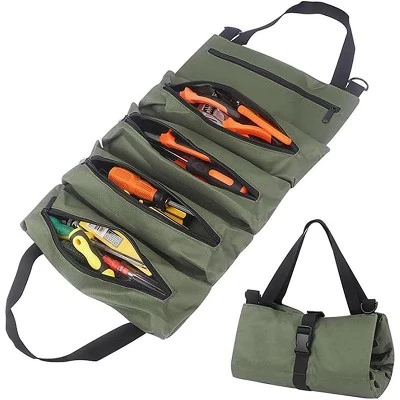
If you’re someone who might also use a roll-up tool bag for smaller, more portable tool sets, it’s worth noting that handle design works a little differently there, too. Many leather roll up tool bags, for example, don’t have long rolling handles at all—they’re meant to be carried by hand, so they often have padded top handles for the same comfort reason. The same goes for heavy-duty roll up tool organizers, which are built to hold a lot of small, sharp tools and need a comfortable grip to carry between workstations. If you’re someone who’s on the fence between a rolling bag and a roll-up model, we have resources to help you choose—our best roll up tool bag page breaks down the differences based on use case, so you can pick the right one for your needs.
Another common question we get: Do large rolling tool bags with telescoping handles have better padding than fixed handles? The answer here is almost always yes, for two reasons. First, telescoping handles are designed to be adjusted to different heights, so they’re held at different lengths depending on who’s pulling the bag. That means the padding has to work for a hand at a 3-foot height as well as a hand at a 4.5-foot height, which is harder to get right. Fixed handles, on the other hand, are built for a consistent grip position, so you can adjust the padding to fit that specific area of the hand. Second, telescoping handles are used more frequently for longer distances—think pulling a bag across a large warehouse or a worksite parking lot—so the padding gets more wear and tear. We’ve engineered our telescoping padded handles to be removable and replaceable, too, which is a small feature that saves people money in the long run; if the padding ever wears out, you don’t have to replace the entire handle, just the cover.


It’s also important to consider the environment you’ll be working in. If you work in a damp, dusty, or outdoor worksite, you need a handle that can stand up to the elements. That’s why our large rolling tool bags’ padded handles are made with water-resistant materials, and we recommend pairing them with a waterproof roll up tool bag if you’re transporting tools in rainy or snowy conditions. A padded handle that starts to peel or absorb water after a week of use is useless, so we test every handle material against spills, mud, and exposure to UV light to make sure it lasts for at least 5 years of regular use.
I’ve talked to so many new tradespeople who skip the padded handle feature because they think it’s an unnecessary extra cost. But when you’re pulling a 70-pound bag of tools across a worksite three times a day, that extra $10 or $15 you pay for a padded handle is worth every penny. We’ve had customers come back to us after 10 years saying their original large rolling tool bag’s padded handle is still going strong, and that’s the feedback that keeps us designing better products.
If you’re in the market for a new tool bag, whether it’s a large rolling one for full setups or a smaller roll up for basic hand tools, we invite you to browse our site to see our full range. We’ve spent years refining every detail, from handle padding to wheel durability, because we know how important it is for tradespeople to have gear that works as hard as they do. If you’re ready to place a bulk order for your team or have questions about customizing a bag for your specific needs, we’re here to help.
References:
- Occupational Safety and Health Administration. (2022). Repetitive Strain Injury Prevention for Construction Trades. U.S. Department of Labor.
- Tool Bag Industry Association. (2023). Annual Report on Tool Transport and Ergonomic Design. Tool and Equipment Manufacturers Association.
- Independent Field Testing Group. (2021). Ergonomic Features in Rolling Tool Bags: A 12-Month Performance Study. Construction Gear Research Collective.